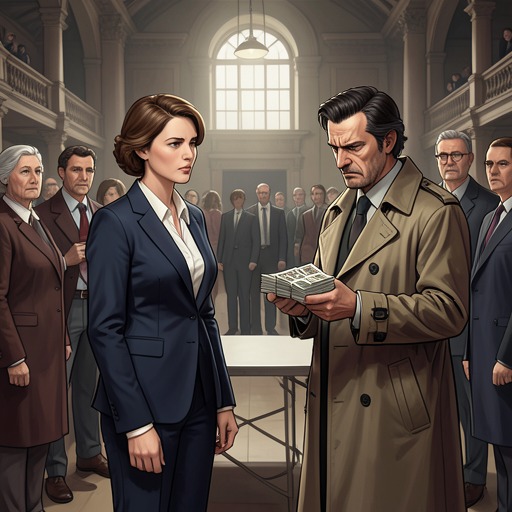
Oedipa’s Call to the Inamorato Anonymous
The Crying of Lot 49Oedipa Maas’s call to Arnold Snarb is her last direct attempt to test whether the clues surrounding the Tristero conceal a real network or an elaborate joke at her expense. Speaking from a desolate San Narciso phone booth, she tells Snarb what her investigation has cost and asks whether their earlier encounter was arranged. His cryptic refusal to explain leaves her isolated, while the call’s aftermath changes the scale of her uncertainty: the question is no longer only who may be manipulating her, but what inheritance Pierce Inverarity has left her in America.
The clue that leads to Snarb
The call grows out of a chain of clues that Oedipa has been unable to treat as isolated coincidences. At The Scope, she found a message inviting readers to contact Kirby “through WASTE only,” with a box number and an unfamiliar symbol beneath it. She copied both into her memo book. Later, at Yoyodyne, she used Kirby’s name as a speculative password with Stanley Koteks; the encounter brought her closer to a recurring sign and to the possibility of a concealed communications system, but did not establish who controlled it.
The symbol returns in material evidence when Genghis Cohen shows her a watermark on a stamp: the WASTE sign, visible black and slightly right of center. Oedipa also sees the postal network in operation. Under a freeway in San Francisco, she finds a green trash can marked W.A.S.T.E., watches a boy deposit letters, adds a sailor’s letter addressed to Fresno, and later follows a carrier collecting the mail. The carrier exchanges sacks near City Hall, travels through Oakland, and eventually takes a Berkeley bus. These observations give the secret system routes, couriers, and a physical mailbox; they do not settle whether its history or purpose has been represented to her truthfully.
Snarb belongs to a different kind of evidence: a person Oedipa met through Inamorati Anonymous, whose story about the post horn might itself have been staged. By the time she calls, the clues have converged around her, but convergence is not proof of coordination. Her question to Snarb is therefore pointedly personal: was their meeting accidental, or had someone arranged it to give her the post-horn story?
The call from San Narciso
Before dialing, Oedipa returns to Echo Courts and drinks bourbon until sunset. She then drives on the freeway with her lights out, an action that carries her toward danger rather than understanding. Shortly after midnight, she finds herself in a phone booth in a desolate, unfamiliar, unlit part of San Narciso. She places a station call to The Greek Way in San Francisco and describes the Inamorato Anonymous member she had met there: acne-marked and fuzz-headed. While she waits through the sound of glasses, laughter, and a jukebox, tears begin to gather.
When Snarb comes to the phone, Oedipa identifies herself as Arnold Snarb, and he explains that he had been in the boys’ room because the men’s room was full. The ordinary, awkward detail of his explanation briefly anchors the conversation in a mundane encounter. Oedipa then tells him, in no more than a minute, what she has learned about the Tristero and what has happened to Dr. Hilarius, Mucho Maas, Metzger, Randolph Driblette, and Mike Fallopian. She tells Snarb that he is the only person she has left to ask, while emphasizing that she does not know his name and does not want it. What she needs is not his identity but an answer about whether he was recruited into a deception.
Oedipa frames the question as an appeal for help, not a demand for disclosure. She says that the possibility of a practical joke has ceased to be amusing, describes having gone drinking and driving on the freeways, and warns that next time she may be more deliberate. She invokes human life and whatever Snarb respects, asking him to help her establish whether the story was arranged. The call thus carries an immediate personal stake: she is trying to find one trustworthy point of contact before her uncertainty becomes dangerous.
A refusal and a break in perspective
After a long stretch of bar noise, Oedipa tells Snarb that the people behind the mystery have saturated her and that from then on she will shut them out. She declares him free of any obligation and releases him to tell her the truth. Snarb answers, “It’s too late.” When Oedipa asks whether he means it is too late for her, he replies, “For me.” He hangs up before she can ask what he means. The call offers no confirmation that Snarb was planted, no explanation of his answer, and no way to continue: Oedipa has no coins left, and by the time she could find change he would be gone.
The failed exchange becomes a scene of physical as well as informational isolation. Oedipa stands between the public phone booth and the rented car at night and tries to orient herself toward the sea, but she has lost her bearings and cannot find the mountains either. The landscape that might have given direction offers no usable boundary. Snarb’s silence does not prove either conspiracy or innocence; it leaves the two explanations open at the moment Oedipa most urgently wants to close them.
The narrative then moves from the interrupted call into a sudden change in how Oedipa experiences San Narciso. The city loses what had seemed its unique identity and becomes a name returned to the larger American landmass. The shift follows the mystery from a possible plot against one woman into a much broader uncertainty: the signs may belong to a hidden system of communication, to Pierce’s reach through his estate, or to an interpretation Oedipa cannot verify. The scene makes the failure of one telephone conversation reverberate across the whole map she has been trying to read.
From investigation to inheritance
The call follows Oedipa’s discovery that every access route to the Tristero might also lead back to the Inverarity estate. She has found Pierce’s ownership behind the shopping center containing Zapf’s Used Books and Tremaine’s surplus store, as well as the Tank Theatre. Emory Bortz teaches at San Narciso College, which Pierce heavily endowed. These connections make her wonder whether the people and clues encountered during her investigation were all somehow Pierce’s men—bought, loyal, or participating in a practical joke. The evidence establishes overlapping connections and ownership; it does not establish the conspiracy she fears.
That distinction is central to the call. Snarb might have been an accidental acquaintance, a messenger within a genuine secret network, or another participant in an expensive and elaborate deception. Oedipa’s appeal cannot distinguish among those possibilities because Snarb ends the conversation before explaining himself. His “For me” introduces a further unknown: the man she hoped could clarify her situation appears to speak from an urgency of his own, but the call supplies no account of it.
Afterward, Oedipa walks along railroad tracks beside the highway, past spurs running into factory property that Pierce may also have owned. She asks herself whether it matters if he owned all of San Narciso. The city becomes an incident within a larger continuity of American landscapes and collective needs. Weeks earlier, she had begun making sense of what Pierce left behind without suspecting that the legacy might be America itself. She can no longer summon an image of the dead man to address or answer, yet the ending gives her a new compassion for the dead man’s apparent search for an exit and for the enigma his efforts produced. The call therefore yields no solution to the Tristero mystery; it marks the point at which the unanswered mystery opens into Oedipa’s unresolved relation to Pierce, his estate, and the country around them.